

If you’re here, you’re looking for more than surface-level hype—you want to understand what’s actually driving today’s biggest gaming trends and how they impact your experience. From breakout indie hits to competitive multiplayer giants, staying ahead means knowing how core game mechanics shape balance, progression, and long-term replayability.
This article breaks down the latest game buzz, analyzes evolving multiplayer metas, and evaluates console performance and optimization strategies that can directly affect how you play. Whether you’re chasing higher ranks, smoother frame rates, or smarter loadout decisions, you’ll find clear, actionable insights tailored to what matters right now.
Our analysis is grounded in hands-on testing, community trend monitoring, and detailed mechanical breakdowns—not just patch note summaries. By the end, you’ll have a sharper understanding of what’s changing, what’s worth your time, and how to adapt quickly in an ever-evolving gaming landscape.
The Heartbeat of Play: Mastering the Core Gameplay Loop
At the center of every great game is its core gameplay loop—the primary set of actions a player repeats. Think of it as the game’s main verb: jump, shoot, build, trade, survive. If a game were a sentence, the loop would be the action word driving it forward.
The Three-Part Structure
Every effective loop follows a simple structure:
- Objective – What the player wants to achieve.
- Action – What the player does.
- Reward – What the player earns.
Take Pac-Man as a classic example:
- Objective: Eat all the dots.
- Action: Navigate the maze while avoiding ghosts.
- Reward: Clear the screen and earn points.
Simple? Yes. Powerful? Absolutely. (There’s a reason it’s survived since arcades ate quarters for breakfast.)
Why It’s Fundamental
Some argue flashy graphics or massive open worlds matter more. But compare A vs B:
- Game A: Stunning visuals, clunky controls.
- Game B: Minimal graphics, silky-smooth movement.
Players stick with Game B. A satisfying, low-friction loop keeps engagement high. A sluggish or confusing one drives players away—no matter how impressive everything else looks.
Optimization Tip
Top-tier titles obsess over polish. Compare the crisp, tactile reload in a modern FPS to a slow, unresponsive animation. One feels empowering; the other feels broken. Pro tip: refine responsiveness before adding features. Even the best core game mechanics fail if the moment-to-moment feel isn’t tight.
Master the loop, and everything else builds naturally from there.
The thrill of choice is what separates a forgettable grind from a legendary raid night in a packed LAN café in Seoul. Great games constantly force you to weigh risk against reward, and that tension is the spark.
Consider resource management. Do I use my powerful, limited-use ultimate ability now on this mini-boss, or save it for the main boss? Burn it early and you might steamroll the lane; hold it too long and you’ve wasted potential damage. Or exploration: do I take the dangerous shortcut that might have better loot? Veterans of Tarkov or Elden Ring know that one wrong turn can cost hours of progress.
However, not every reward loop is meaningful. The “Skinner Box” fallacy reduces play to repetitive button presses for predictable dopamine. There’s no real agency. True risk/reward demands that player choice and skill influence the outcome, not just a timer or loot table. (Grinding daily quests isn’t strategy.)
Mechanically, health, ammo, and currency systems are tuned to create these stakes. Low health amplifies tension; scarce ammo rewards precision; volatile in-game economies punish reckless spending. In competitive metas, even cooldown tracking becomes high-level poker. Understanding core game mechanics clarifies why these systems matter. Ultimately, meaningful design trusts players to gamble wisely, because without risk, victory feels hollow, like beating a tutorial bot. And that tension keeps communities talking long-term afterwards.
Putting You in Control: The Power of Player Agency
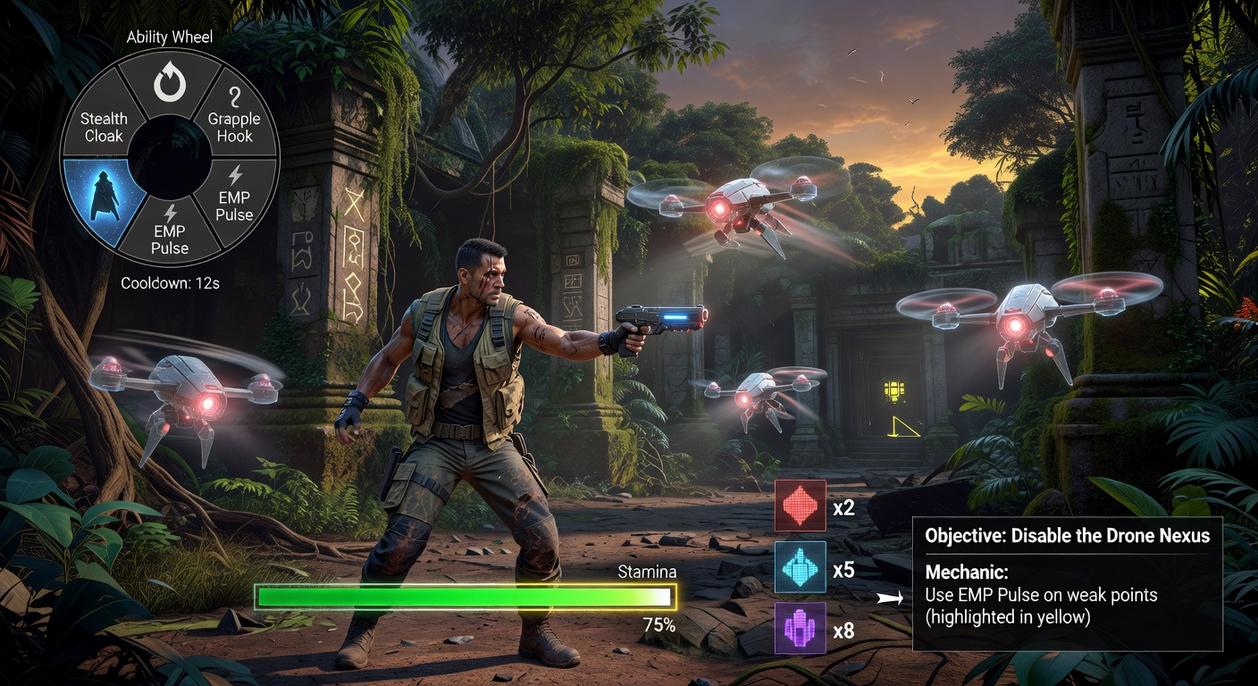
Player agency is the ability to make meaningful choices that shape a game’s world and outcomes. In simple terms, it’s the feeling that my actions matter. Without it, you’re just pressing buttons. With it, you’re directing the story.
The Spectrum of Agency Across Genres
Agency isn’t one-size-fits-all. Instead, it shows up differently depending on design priorities and core game mechanics.
- RPGs (Role-Playing Games) – Branching dialogue, moral decisions, and questlines define your path. Think The Witcher 3: save a character or let them fall, and the world reacts.
- Strategy Games – Choice lives in unit composition and battlefield positioning. In StarCraft, your build order can mean dominance or defeat.
- Action Games – Movement and combat decisions take center stage. Mastering timing and loadouts—like those discussed in advanced combat strategies for competitive players—creates tactical freedom.
Now compare two extremes. A Telltale-style narrative offers branching consequences (high agency), while a linear shooter may limit choices to weapon selection (lower agency). Some argue the latter lacks depth. However, even constrained systems can deliver agency through skill expression—precision aiming versus aggressive flanking, for example.
Ultimately, higher agency strengthens immersion. When players see outcomes shift because of their decisions, engagement rises (and suddenly “just one more mission” turns into 2 a.m.).
Reading the Game: Why Clarity and Feedback Are King
First and foremost, clarity is the backbone of any great game. The Principle of Clarity means the game clearly communicates its rules, your status, and the state of the world. What’s your health? Where’s the objective? Is that enemy attacking or just posturing? When this information is obvious, you make smarter decisions faster—and that feels empowering (not frustrating).
Equally important, The Role of Feedback shapes how satisfying those decisions feel. Feedback is the game’s response to your actions: visual hit markers, a sharp “critical hit” sound, or controller vibration. Great feedback—like a chunky headshot sound in a shooter—confirms mastery. Poor feedback, where enemies barely react, makes everything feel floaty and confusing.
As a result, responsive controls and high frame rates on console aren’t luxuries; they’re essential for delivering immediate, clear feedback. Nail this, and core game mechanics shine—making every win feel earned.
Mastering the Meta and Mechanics That Matter
You came here to cut through the noise and truly understand today’s trending game buzz, evolving multiplayer meta, and the core game mechanics that separate casual play from consistent wins. Now you have a clearer picture of how optimization tweaks, smart console choices, and strategic adjustments directly impact your performance.
The frustration of falling behind in ranked matches, struggling with inconsistent frame rates, or misreading the current meta is real. Games evolve fast—and if you’re not adapting, you’re losing ground. Mastering the core game mechanics and staying aligned with the current meta isn’t optional anymore; it’s the difference between reacting and dominating.
Here’s your next move: apply one optimization tip today, refine one mechanic you’ve been neglecting, and review how your current setup supports your playstyle. Then dive deeper into the latest meta breakdowns and performance guides to stay ahead of every patch.
Thousands of competitive players rely on our up-to-date insights to sharpen their edge and stay ahead of balance changes. Don’t let outdated strategies cost you another match—level up your gameplay now and start winning with confidence.
 There is a specific skill involved in explaining something clearly — one that is completely separate from actually knowing the subject. Larry Henryokson has both. They has spent years working with console releases and reviews in a hands-on capacity, and an equal amount of time figuring out how to translate that experience into writing that people with different backgrounds can actually absorb and use.
Larry tends to approach complex subjects — Console Releases and Reviews, Dorgenven Multiplayer Meta Explored, Gaming Mechanics and Strategies being good examples — by starting with what the reader already knows, then building outward from there rather than dropping them in the deep end. It sounds like a small thing. In practice it makes a significant difference in whether someone finishes the article or abandons it halfway through. They is also good at knowing when to stop — a surprisingly underrated skill. Some writers bury useful information under so many caveats and qualifications that the point disappears. Larry knows where the point is and gets there without too many detours.
The practical effect of all this is that people who read Larry's work tend to come away actually capable of doing something with it. Not just vaguely informed — actually capable. For a writer working in console releases and reviews, that is probably the best possible outcome, and it's the standard Larry holds they's own work to.
There is a specific skill involved in explaining something clearly — one that is completely separate from actually knowing the subject. Larry Henryokson has both. They has spent years working with console releases and reviews in a hands-on capacity, and an equal amount of time figuring out how to translate that experience into writing that people with different backgrounds can actually absorb and use.
Larry tends to approach complex subjects — Console Releases and Reviews, Dorgenven Multiplayer Meta Explored, Gaming Mechanics and Strategies being good examples — by starting with what the reader already knows, then building outward from there rather than dropping them in the deep end. It sounds like a small thing. In practice it makes a significant difference in whether someone finishes the article or abandons it halfway through. They is also good at knowing when to stop — a surprisingly underrated skill. Some writers bury useful information under so many caveats and qualifications that the point disappears. Larry knows where the point is and gets there without too many detours.
The practical effect of all this is that people who read Larry's work tend to come away actually capable of doing something with it. Not just vaguely informed — actually capable. For a writer working in console releases and reviews, that is probably the best possible outcome, and it's the standard Larry holds they's own work to.